Introduction: Understanding the Condition
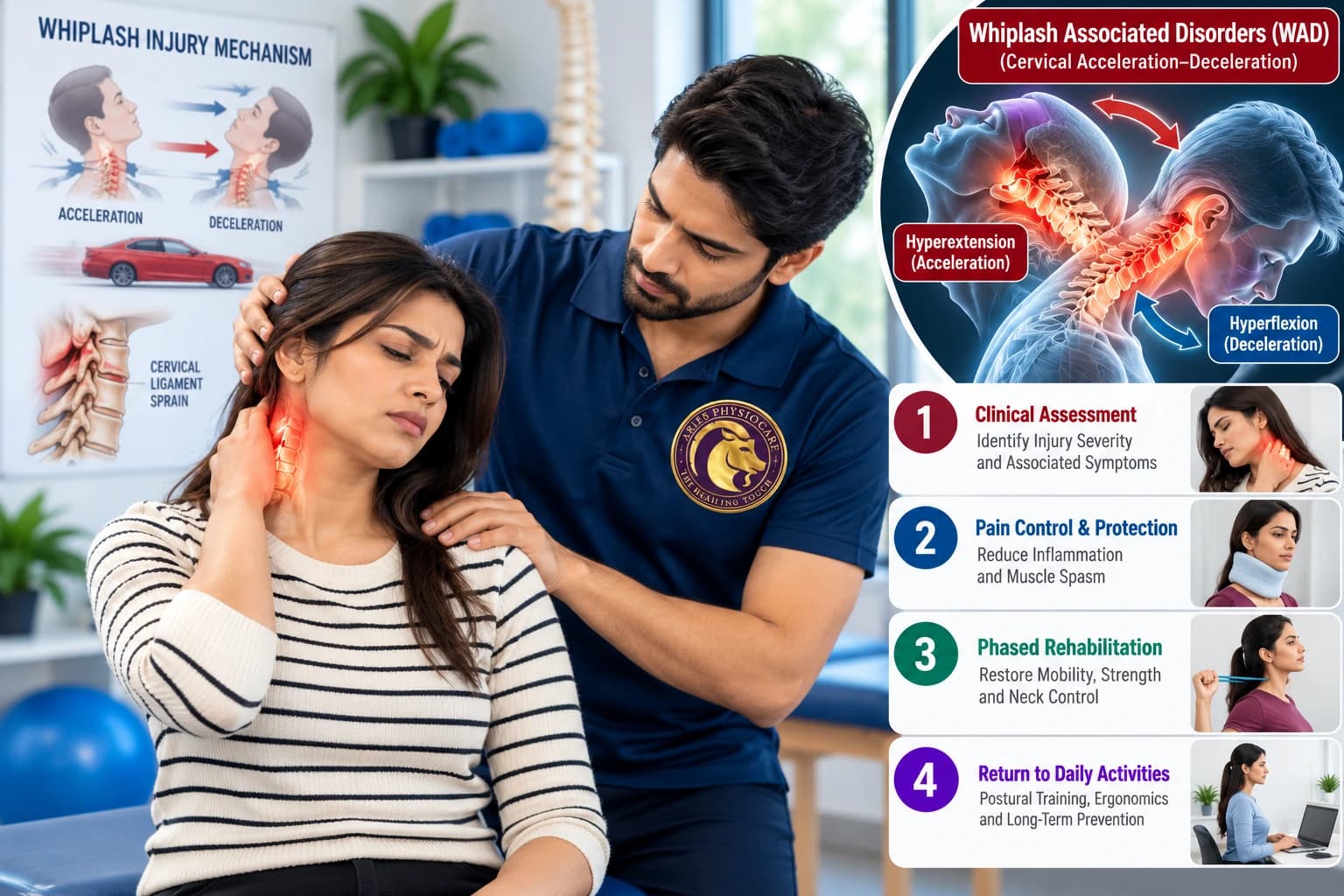
Whiplash Associated Disorders (WAD) encompass a complex spectrum of soft tissue, articular, and neurological injuries resulting from an acute cervical acceleration-deceleration mechanism. Most commonly precipitated by rear-end motor vehicle collisions, sporting impacts, or sudden falls, the head undergoes rapid, unconstrained hyperextension followed immediately by hyperflexion. This violent kinematic excursion causes micro-tears in anterior cervical ligaments, facet joint capsule sprains, muscular contusions, and potential neural concussion. International clinical guidelines strongly emphasize that early active, non-provocative physiotherapy accelerates tissue healing and prevents transition into chronic disability.
Common Symptoms
Key clinical indicators and functional presentations:
- Neck pain and marked stiffness that typically peaks 24 to 72 hours following the traumatic event
- Severe restriction in cervical range of motion in all planes accompanied by defensive muscular splinting
- Suboccipital tension headaches radiating forward across the cranium
- Dizziness, lightheadedness, or sensation of spatial disequilibrium (cervicogenic dizziness)
- Visual disturbances, blurred vision, or photophobia resulting from autonomic irritation
- Intermittent radiating shoulder, arm, or interscapular discomfort
- Cognitive fatigue, reduced concentration, irritability, and movement apprehension (kinesiophobia)
Causes & Clinical Diagnosis
Etiological drivers and diagnostic assessment:
- Motor vehicle collisions generating violent sagittal or oblique acceleration-deceleration forces
- Contact sports collisions (rugby, football, martial arts) or equestrian falls
- Slip-and-fall incidents where the head impacts an unyielding surface
- Clinical diagnosis utilizes the Quebec Task Force (QTF) Whiplash Classification (Grades I–IV), the Canadian C-Spine Rule to rule out fractures, and specialized cervical sensorimotor screening.
Pathophysiology & Biomechanical Impact
During the rapid extension-flexion kinematic sequence, the cervical spine forms an S-shaped curve where lower segments (C5–C7) hyperextend while upper segments (C1–C3) hyperflex. This non-physiological motion strains the anterior longitudinal ligament, tears facet joint capsules, and compresses posterior vertebral arches. The resultant tissue damage produces neurogenic inflammation, extensive paraspinal muscle edema, and disruption of cervical proprioceptive mechanoreceptors located in high density within the deep suboccipital muscles.
Evidence-Based Physiotherapy Protocols
At Aries PhysioCare, our physical therapists implement clinician-administered rehabilitation protocols:
- Phase 1 (Acute Phase, 0–2 weeks): Gentle active-assisted movements within pain-free arcs, education to dispel kinesiophobia, and avoidance of prolonged rigid cervical collars
- Calibrated electro-analgesia: TENS and low-level laser therapy to downregulate acute pain signaling and reduce protective spasms
- Phase 2 (Subacute Phase, 2–6 weeks): Gentle Maitland Grade I and II joint mobilizations to restore capsular glide without tensile strain
- Sensorimotor and proprioceptive retraining: Laser-guided head-repositioning accuracy drills to recalibrate balance and vestibular coordination
- Gentle deep cervical flexor and extensor motor control retraining under direct clinician supervision
- Phase 3 (Remodeling Phase, 6+ weeks): Progressive functional reconditioning and return-to-activity protocols
Home Care & Ergonomic Strategies
Supporting recovery through evidence-based ergonomic habits and self-care:
- Maintain gentle daily movement; do not wear a soft cervical collar for more than 48 hours unless explicitly directed by your physician
- Apply cold therapy packs to the neck for 15 minutes every 3 to 4 hours during the initial 48 hours to minimize inflammatory edema
- Transition to moist heat applications after 72 hours to relieve secondary paraspinal muscle guarding
- Rest in supportive positions using a contoured cervical pillow that prevents the head from falling into side-bent angles
- Practice diaphragmatic relaxation breathing to calm heightened sympathetic nervous system activity
- Avoid high-impact activities, amusement park rides, or strenuous lifting during the initial 6 weeks of tissue remodeling
When to Contact Us
Recover fully from whiplash trauma under expert clinical guidance. Contact Aries PhysioCare today for specialized in-home post-whiplash rehabilitation and sensorimotor recovery.