
Introduction: Understanding Spondylolisthesis
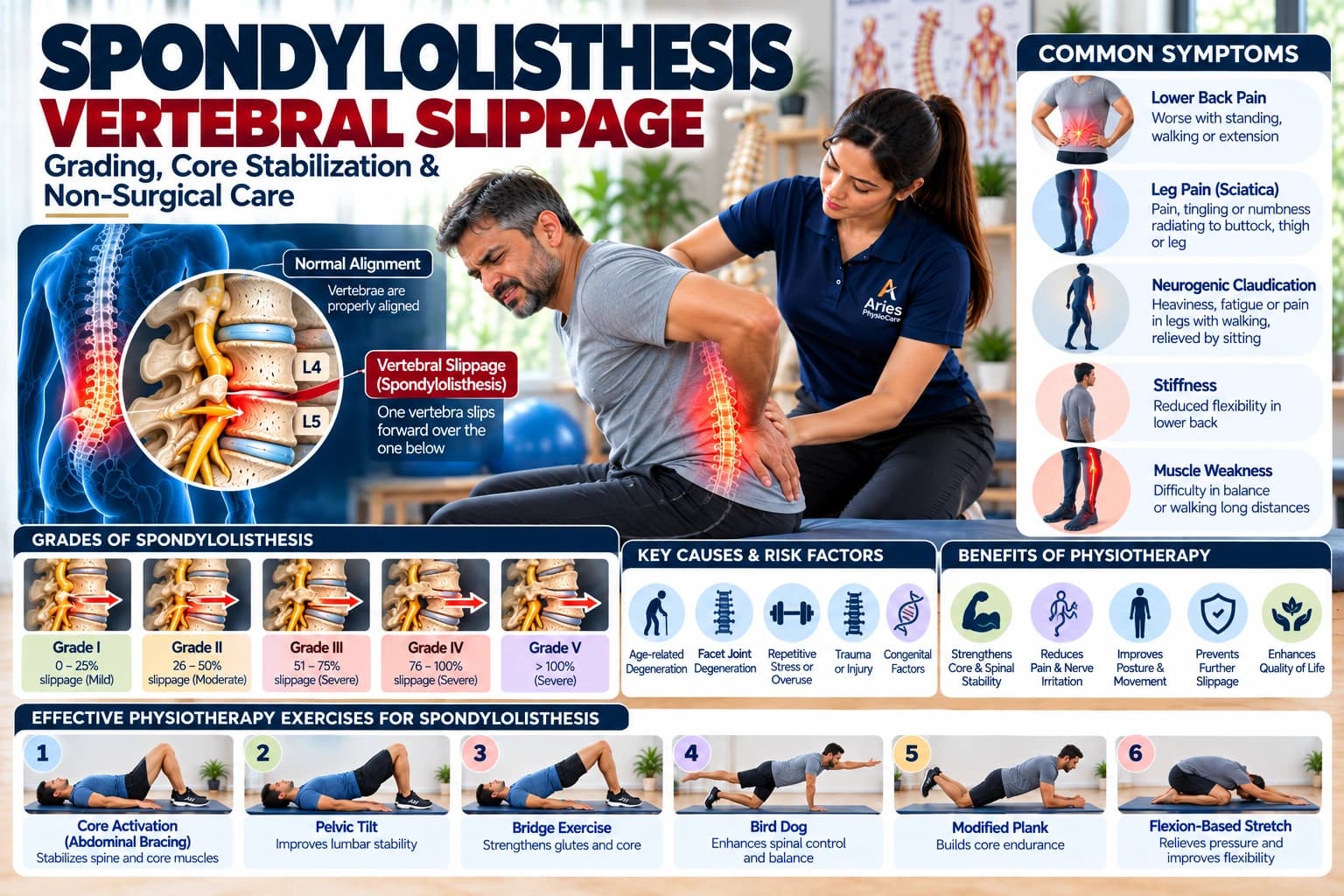
Spondylolisthesis occurs when one vertebra slips forward (anterolisthesis) or backward (retrolisthesis) relative to the vertebra beneath it, most commonly at L4-L5 or L5-S1. It is classified into isthmic (stress fracture of the pars interarticularis, often seen in young athletes) or degenerative (secondary to facet joint wear in older adults). Graded I through IV, the vast majority of Grade I (<25% slip) and Grade II (25–50% slip) cases remain completely stable and symptom-free through specialized core physiotherapy without requiring spinal fusion surgery.
Common Symptoms of Spondylolisthesis
Mechanical and structural signs:
- Localized lower back pain that intensifies during spinal hyperextension
- Palpable "step-off" deformity along the spinous processes in higher-grade slips
- Tightness and severe shortening of the hamstring muscles
- Waddling gait pattern with restricted hip extension
- Sciatic-like nerve symptoms if the slipping vertebra pinches an exit nerve root
- Difficulty standing upright for extended periods without leaning on furniture
- Muscle fatigue in paraspinals after minor household chores
Causes & Clinical Diagnosis
Etiological classifications:
- Isthmic: Pars interarticularis defect from repetitive hyperextension (gymnastics, cricket bowling)
- Degenerative: Chronic facet joint arthritis and disc erosion in older adults
- Congenital dysplastic facet orientation
- Diagnosis is confirmed via standing lateral and flexion-extension dynamic X-rays to assess slip percentage and mechanical instability.
Pathophysiology & Biomechanical Impact
With loss of bony or ligamentous restraint, anterior shear forces overcome the intervertebral disc. The surrounding muscular sling—particularly the hamstrings and erector spinae—contracts forcefully to arrest further displacement, causing severe myofascial pain.
Evidence-Based Physiotherapy Protocols
- Deep core bracing (transversus abdominis and internal obliques) to build a dynamic internal spinal brace
- Strict avoidance of lumbar hyperextension and aggressive spinal manipulation
- Hamstring lengthening and hip flexor stretching to restore neutral pelvic balance
- Lumbo-pelvic stabilization drills and progressive neutral spine motor control under therapist supervision
Home Care & Ergonomic Strategies
- Never sleep on your stomach, which pushes the lumbar spine into excessive lordosis
- Sleep on your side with knees bent or on your back with a pillow under your knees
- Practice posterior pelvic tilts while lying flat on your back daily
- Lift objects using strict hip hinge mechanics with a flat, braced back
When to Contact Us
Stabilize your spine and eliminate pain safely. Contact Aries PhysioCare for expert home physiotherapy and personalized spondylolisthesis stabilization programs.