Introduction: Understanding the Condition
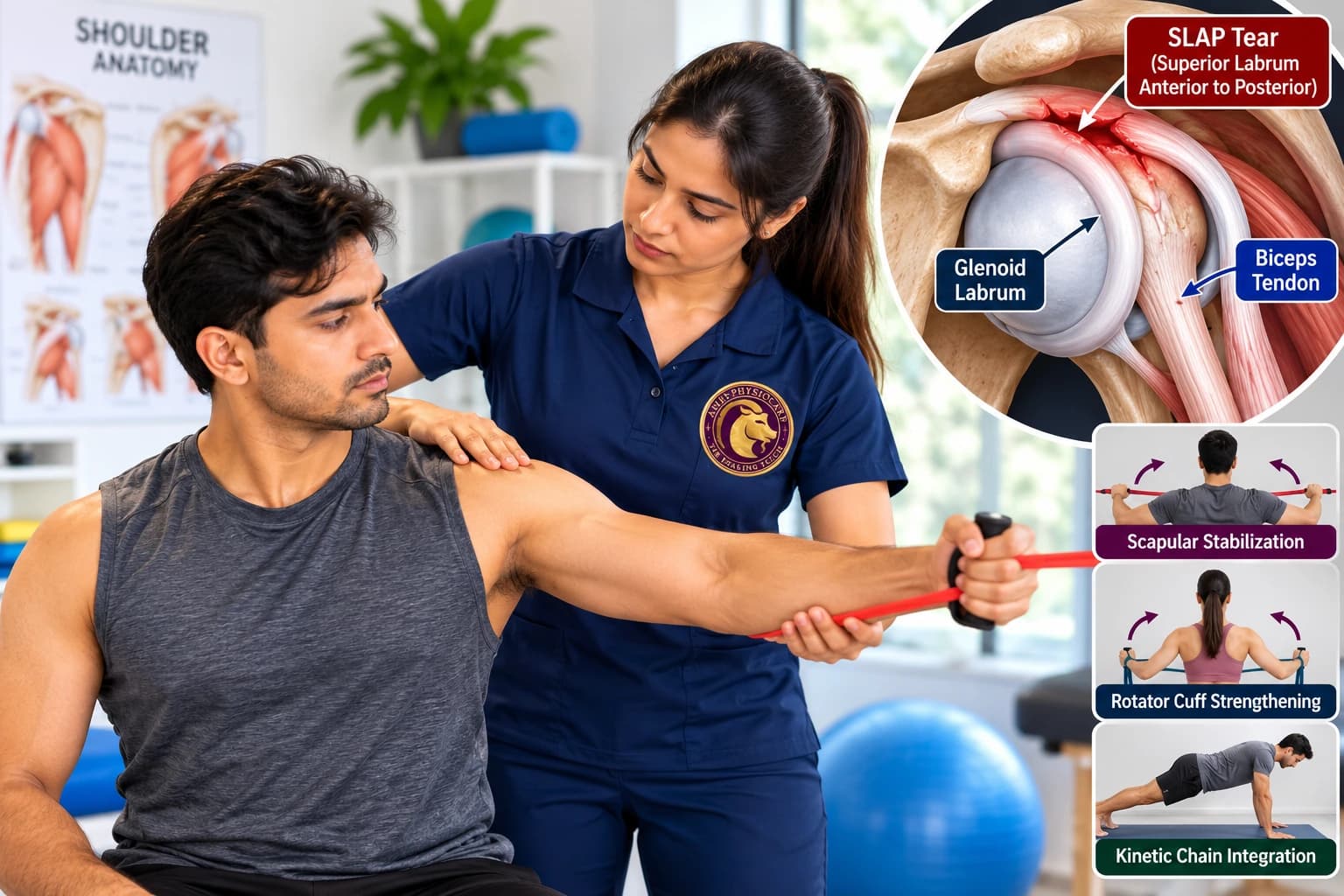
A SLAP tear refers to an injury of the Superior Labrum extending Anterior to Posterior, directly involving the critical anchorage zone where the long head of the biceps brachii tendon attaches to the superior glenoid tubercle. Classified into four primary Snyder types (and up to ten expanded variations), SLAP tears are especially prevalent in overhead athletes, manual laborers, and individuals who sustain falls onto an outstretched hand. When the superior labrum detaches, the bicipital anchor loses structural stability, leading to profound pain during late cocking and deceleration phases of movement. Modern clinical evidence confirms that non-operative physical therapy succeeds in resolving symptoms in over 70% of non-type-III/IV SLAP tears.
Common Symptoms
Key clinical indicators and functional presentations:
- Sharp, clicking pain situated deep within the superior shoulder during overhead movements
- Distinct mechanical clicking, popping, or 'dead arm' sensation during throwing or heavy lifting
- Aching discomfort concentrated over the anterior shoulder along the bicipital groove
- Loss of shoulder rotational velocity, throwing power, and stamina during athletic tasks
- Pain provoked when lifting objects overhead with the palm facing upward (biceps load)
- Marked posterior shoulder tightness paired with Glenohumeral Internal Rotation Deficit (GIRD)
Causes & Clinical Diagnosis
Etiological drivers and diagnostic assessment:
- Repetitive overhead 'peel-back' mechanism during extreme abduction and external rotation
- Acute traction injury caused by sudden jerking of the arm or catching a heavy object
- Direct axial compression force from falling onto an outstretched, slightly abducted arm
- Clinical diagnosis involves targeted orthopedic testing (O'Brien's test, Biceps Load II test, Speed's test, Dynamic Labral Shear test) correlated with high-resolution magnetic resonance arthrography (MRA).
Pathophysiology & Biomechanical Impact
The biomechanics of a SLAP tear are largely governed by the 'peel-back' mechanism. In extreme abduction and maximal external rotation, the vector of the long head of the biceps changes, transmitting high torsional shear stress to the superior labrum. Over time, this peels the superior labrum off the glenoid bone. Because the biceps anchor functions as a primary restraint against excessive external rotation and anterior translation, its detachment destabilizes the anterior-superior glenohumeral joint. Consequently, the rotator cuff experiences massive compensatory overload, frequently precipitating secondary tendinopathy.
Evidence-Based Physiotherapy Protocols
At Aries PhysioCare, our physical therapists implement clinician-administered rehabilitation protocols:
- Resolution of Glenohumeral Internal Rotation Deficit (GIRD): Gentle therapist-applied posterior-inferior capsular mobilizations to restore internal rotation without stressing the anterior capsule
- Rotator cuff force couple re-education: Closed-chain dynamic stabilization drills to reduce relying on the biceps anchor for glenohumeral containment
- Scapulothoracic kinetic chain recalibration: Strengthening the lower trapezius and serratus anterior to optimize scapular positioning and eliminate mechanical pinch
- Class-IV Laser Therapy and IFT applied along the bicipital groove and superior labrum to reduce acute tenosynovitis and deep joint ache
- Neuromuscular re-education of the eccentric decelerators (infraspinatus, teres minor, posterior deltoid) under direct physical therapist monitoring
- Trunk and hip kinetic chain integration to eliminate excessive rotational torque demands on the shoulder girdle
Home Care & Ergonomic Strategies
Supporting recovery through evidence-based ergonomic habits and self-care:
- Avoid extreme overhead activities and explosive throwing or spiking motions during the initial rehabilitation phase
- Modify gym workouts: Eliminate behind-the-neck presses, wide-grip bench presses, and heavy bicep curls with extended elbows
- Ensure workstation setups keep elbows supported at 90 degrees with the mouse close to the keyboard to prevent bicipital anchor strain
- Apply cryotherapy for 15 minutes over the anterior-superior shoulder following demanding physical activities
- Sleep on your back or unaffected side with a pillow supporting the forearm to prevent superior joint compression
- Avoid aggressive passive arm stretching across the chest without proper therapist stabilization of the scapula
When to Contact Us
Deep, clicking shoulder pain during overhead reaching demands specialized clinical expertise. Contact Aries PhysioCare today for a thorough SLAP tear and kinetic chain evaluation.