Introduction: Understanding the Condition
Undergoing orthopedic shoulder surgery—whether an arthroscopic rotator cuff repair, Bankart labral reconstruction, subacromial decompression, or distal clavicle excision—is merely the first step toward musculoskeletal recovery. The surgical repair fixes structural tissue, but functional restoration depends entirely on structured, evidence-based post-operative physical therapy. Biological tendon-to-bone and labrum-to-bone healing requires a precise balance: early controlled passive motion is necessary to prevent debilitating capsular adhesions, yet premature active loading can rupture delicate suture anchors. A licensed physical therapist navigates this biological timeline across distinct protection, mobility, and strengthening phases.
Common Symptoms
Key clinical indicators and functional presentations:
- Post-operative surgical pain, tissue swelling, and bruising radiating into the arm and chest wall
- Strict requirement for continuous sling immobilization with an abduction pillow to protect surgical repairs
- Marked weakness and total inability to actively lift the operated arm during early healing phases
- Periscapular muscle spasms and neck stiffness from sustained sling wear
- Apprehension and fear of damaging newly anchored tendons during basic personal hygiene
- Gradual development of joint stiffness that requires skilled, gentle physical therapist mobilization
Causes & Clinical Diagnosis
Etiological drivers and diagnostic assessment:
- Surgical anchoring of torn rotator cuff tendons to the greater tuberosity using suture anchors
- Arthroscopic re-attachment of a detached glenoid labrum (Bankart or SLAP repair)
- Acromioplasty, bursectomy, or capsular release performed to address chronic mechanical impingement
- Rehabilitation protocols are strictly dictated by operative findings, tissue quality, surgical fixation strength, and surgeon-specific guidelines correlated with serial clinical evaluations.
Pathophysiology & Biomechanical Impact
Tendon-to-bone healing progresses through three distinct biological stages: inflammatory phase (weeks 0–2), proliferative phase (weeks 2–6), and remodeling phase (weeks 6–24). During early healing, repair integrity relies completely on suture anchor tensile strength. Premature active muscle contraction creates massive shear forces across the anchor site, risking construct pull-out. Conversely, prolonged total immobility results in severe capsular contracture, tendon adhesion to the bursa, and progressive muscle atrophy. Skilled passive mobilization provides gentle mechanotransduction signals that align newly forming collagen fibers without stressing the repair construct.
Evidence-Based Physiotherapy Protocols
At Aries PhysioCare, our physical therapists implement clinician-administered rehabilitation protocols:
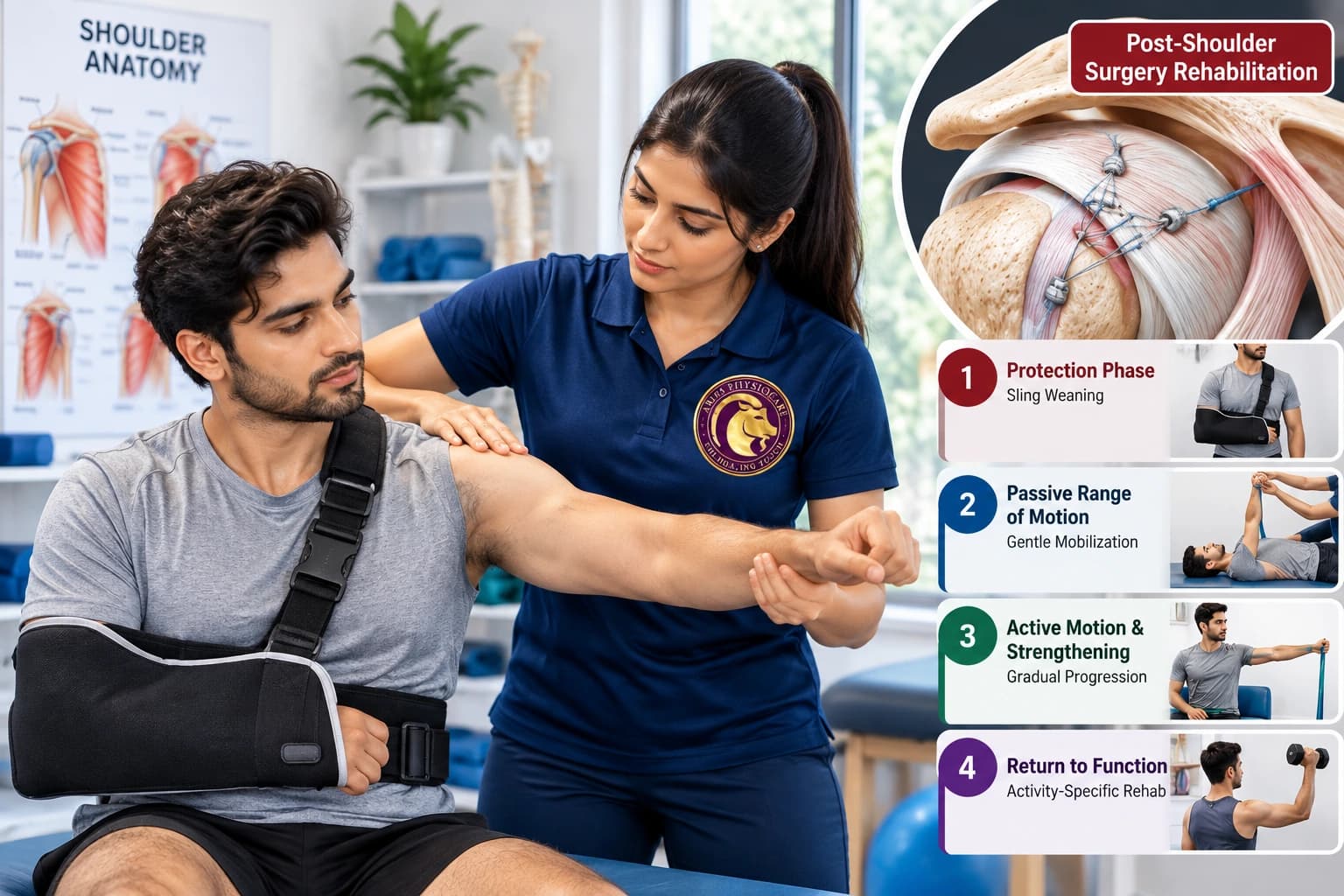
- Phase I (Protection & Passive Mobility, Weeks 0–6): Strict sling management, therapist-administered true passive range of motion within surgeon-specified limits, and active wrist/hand mobility
- Class-IV Laser Therapy and gentle cryo-compression applied over portal sites to control post-surgical inflammation and accelerate soft tissue healing
- Phase II (Active-Assisted & Early Active Mobility, Weeks 6–12): Weaning from the sling, initiating active-assisted range of motion, and gentle isometric rotator cuff co-contraction
- Maitland manual therapy: Gentle Grade I and II joint mobilizations to prevent joint capsule cross-linking and capsulolabral contracture
- Phase III (Strengthening & Scapular Dynamic Control, Weeks 12–20): Progressive closed-chain kinetic stabilization and light isotonic loading under direct physical therapist monitoring
- Phase IV (Advanced Functional & Return to Activity, Weeks 20+): Multi-planar kinetic chain integration, proprioceptive neuromuscular drills, and functional movement re-education
Home Care & Ergonomic Strategies
Supporting recovery through evidence-based ergonomic habits and self-care:
- Wear your post-operative sling with the abduction pillow strictly as directed by your surgical team, especially during sleep and community ambulation
- Perform prescribed active wrist, hand, and finger pumping drills several times daily to maintain circulation and prevent distal edema
- Do not actively lift, push, pull, or carry any objects with the operated arm during the protected healing phases
- Apply cryotherapy packs for 15 to 20 minutes across the shoulder dressing to control post-operative swelling and reduce dependence on oral analgesics
- Sleep in a reclined chair or propped up with multiple pillows in bed, keeping the operated arm supported to prevent posterior joint sagging
- Refrain from removing the sling to attempt unguided arm movements or aggressive self-stretching before clinical authorization
When to Contact Us
Protect your surgical investment and achieve a full, confident recovery. Contact Aries PhysioCare today to begin your specialized post-operative shoulder rehabilitation program.