

Introduction: Understanding Facet Joint Syndrome
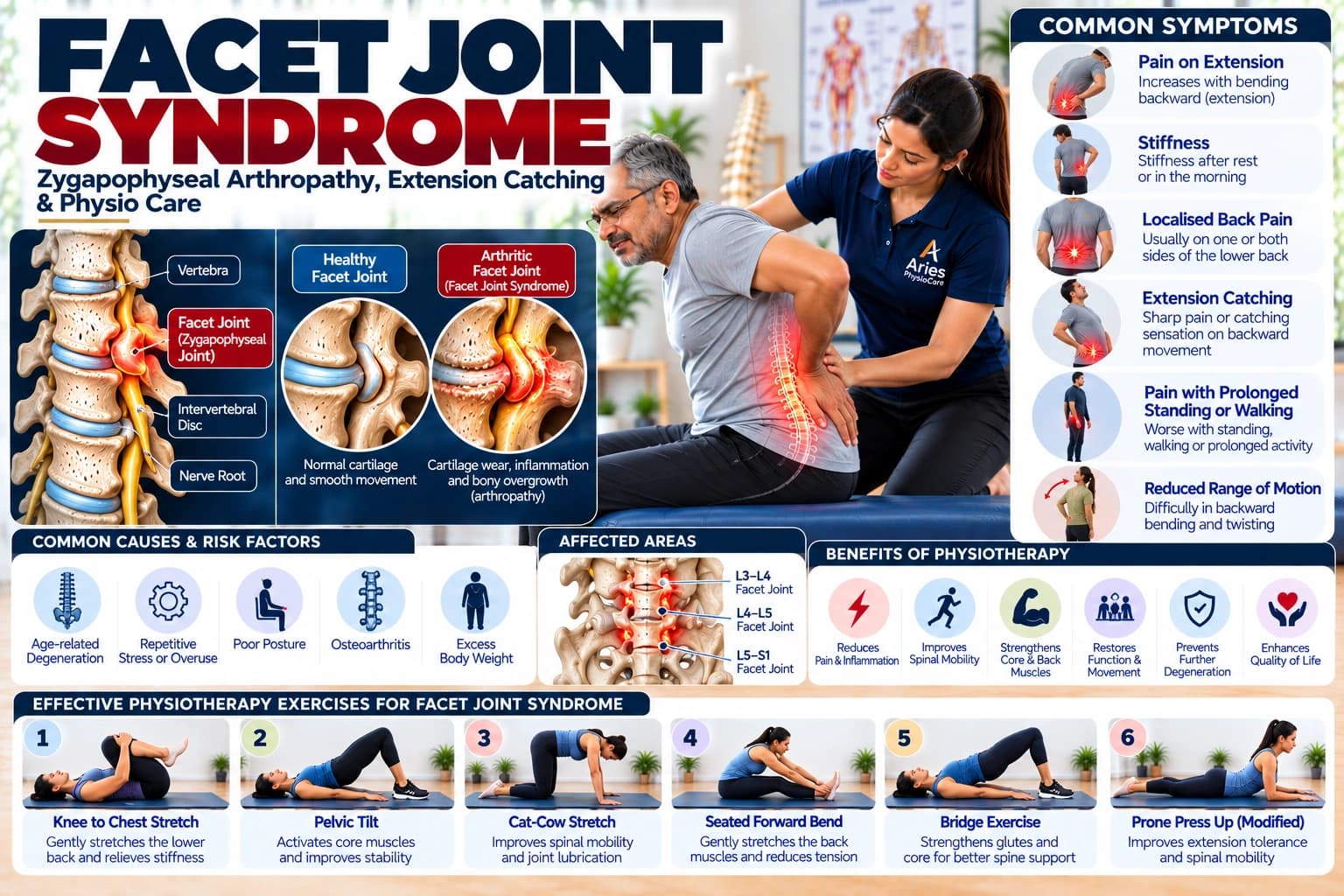
Facet joints (zygapophyseal joints) are paired synovial joints located on the posterior arch of every spinal vertebra, responsible for guiding spinal motion and preventing excessive twisting. Like the knee or finger joints, facet joints are lined with smooth articular cartilage and enclosed within a lubricated capsule. Facet Joint Syndrome occurs when these joints become arthritic, inflamed, or mechanically locked, causing localized back pain that worsens dramatically during backward bending and rotation.
Common Symptoms of Facet Syndrome
Extension-dependent presentation:
- Sharp, localized catching pain in the lower back slightly to one or both sides of the midline
- Significant exacerbation of pain when arching backward (lumbar extension) or twisting
- Deep ache radiating into the buttock, hip, or posterior thigh (rarely below the knee)
- Morning spinal stiffness that eases after light movement
- Discomfort after prolonged standing or walking in high-heeled shoes
- Muscle guarding and localized tender trigger points in the adjacent lumbar multifidus
- Instantaneous relief when sitting down, curling into a ball, or bending forward
Causes & Clinical Diagnosis
Mechanisms of injury:
- Loss of intervertebral disc height shifting compressive loads posteriorly onto the facet joints
- Repetitive hyperextension activities (swimming butterfly, gymnastics, overhead sports)
- Sudden awkward rotational twist while carrying a load
- Diagnosis is confirmed via the Kemp's / Quadrant test (extension, lateral flexion, and rotation reproducing local pain) and diagnostic facet joint blocks when indicated.
Pathophysiology & Biomechanical Impact
Repetitive facet impingement causes subchondral bone sclerosis, cartilage fibrillation, and capsular synovial hypertrophy. In acute "facet lock" episodes, a tiny fibro-adipose meniscoid fold becomes pinched between the articular surfaces, triggering intense local reflex muscle spasms.
Evidence-Based Physiotherapy Protocols
- Gentle flexion-biased gapping mobilizations to separate and decompress the facet articular surfaces
- Myofascial trigger point release targeting the lumbar erectors and quadratus lumborum
- Core stability training focusing on anterior abdominal control to prevent hyperlordosis
- Deep tissue laser and high-frequency electrotherapy for rapid capsular anti-inflammatory relief
Home Care & Ergonomic Strategies
- Avoid sleeping flat on your stomach; place a pillow under your abdomen if prone is necessary
- Perform double knee-to-chest and child's pose stretches daily to gap and relax facet joints
- Avoid prolonged standing in static postures; alternate weight using a small footrest
- Wear flat, supportive footwear that promotes neutral pelvic posture
When to Contact Us
Free locked facet joints and eliminate back pain. Contact Aries PhysioCare for specialized home physiotherapy and expert spinal joint mobilization.